Author: seekingGood

A Conference on Democracy

“Democracy has dominated as a globally promoted and accepted form or governance not because it is perfect or because it, without fail, elects the best leaders or even very good leaders all of the time but because it is supposed to be self-correcting and potentially self-enforcing.”    ~Susan Hyde

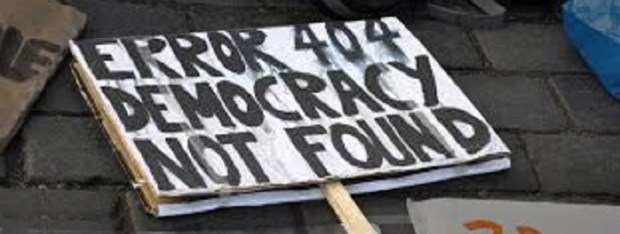
democracy. not found - edited.jpg

For some time now, citizens of the United States have increasingly begun to question just how “self-correcting” or “self-enforcing” American democracy might be. Some of our most prominent thinkers have begun to ask poignant questions about the state of democracy, both in American and throughout the world. (more…)

Death of Democracy II

Part 2

Last week we offered a link to Lee Drutman’s article “We need political parties. But their rabid partisanship could destroy American democracy” on Vox, September 5th, 2017.  This week, in Death of Democracy – Part 2 (an admittedly transitional post for the sake of relative brevity of Part 3) we consider some of the antecedents to the democracy we see melting all around us.

Democracy short with flag.jpgImage by alexander parms

(more…)

Death of Democracy I

Part 1

Before the [civil] war, it was said ‘the United States are’, grammatically it was spoken that way and was thought of as a collection of independent states. And after the war it was always ‘the United States is’ as we say today without being self-conscious at all.

~ Shelby Foote, historian

“We the People of the United States, in Order to form a more perfect Union…”   So begins the preamble to the Constitution of the United States.   “We the People…” began with the idea of banding together in the spirit of democracy, in order to “establish Justice, insure domestic Tranquility and secure the Blessings of Liberty to ourselves and our Posterity…”  Oh, well! Could this period in which we now live represent the beginning of the death of the democratic experiment that was and is supposed to be the United States?

charlottesville.jpgCharlottesville, 2017  – image by Andalou Agency/Getty Images

As a second follow-up to Tim Snyder’s article On Tyranny, the post this week links to a lengthy article only briefly mentioned in last week’s post.  The article is called “We need political parties. But their rabid partisanship could destroy American democracy” (which appeared in Vox on September 5th, 2017).   The article, by Lee Drutman  is quite long, but well worth working your way through as it presents a series of issues we should all consider, including:

  • Our fundamental disagreement about what it means to be an “American”
  • The value of political parties
  • Reasons for why we maintain relatively intractable political positions and staunchly maintained polarization
  • How and why division in current U.S. politics is preventing democracy from functioning as it should
  • How the current political climate in the U.S. threatens to create a breaking point akin to the Civil War
  • That inequality and polarization have grown in tandem for the last few decades
  • That the intrusion of money into the electoral process is fueling voter discontent and the disjuncture between the public (actual constituents) and campaign donors (paying constituents)’.

As mentioned, the article is lengthy, not very sexy, but well worth the effort to understand what it presents.


Extending the Drutman article’s focus on political division, next week’s post– Death of Democracy – Part 2—frames this problem into a slightly more embedded historical context, reaching toward addressing our need not only for less division but toward more proactive socio-political solidarity.


Make Peace Every Step

Victor-Narro-Workshop - cropped.jpg

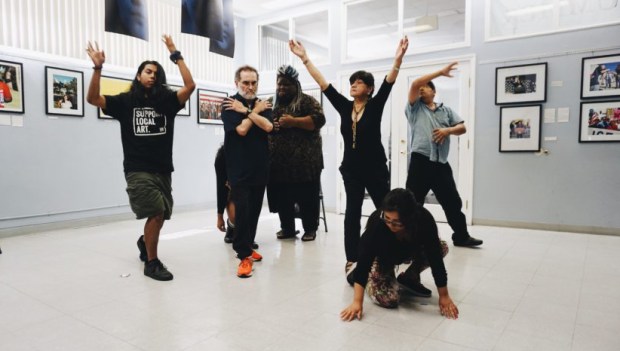
Social justice innovator Victor Narro, arms crossed, participates in a Creative Self-Care workshop at Teada Productions in Los Angeles. (Texas Isaiah)

We are working on a post involving the topic of nonviolence and its place within tense situations such as occurred in Charlottesville.  While researching the piece, we came across an article called “Power to the Peaceful” in an August 2017 post presented by truthdig!  Take a look.  You might find the article and the embedded video inspiring.

Have you thought about adopting a non-violent stance within the context of protests or, even better (and harder), in EveryDayLife?  While many of us talk about nonviolence from a theoretical point of view how often do we exercise it?  Many might suppose the issue does not arise in the flow of day to day occurrences?  No?  That troublesome neighbor, co-worker, spouse or friend can often present a perfect opportunity to see ourselves as true, often times sacrificial, peacemakers.  Consider these six ideas from Dr. Martin Luther King.

Six pillars of nonviolent resistance

  1. Do not mistake nonviolence for passivity or cowardice.
  2. Do not seek to defeat or humiliate the opponent, but to win his friendship and understanding.
  3. Remember that those who perpetrate violence are often victims themselves.
  4. Accept suffering, if necessary, without retaliation, because unearned suffering is redemptive and can educate and transform.
  5. Meet hate with love—not the sentimental kind, but an active love, of understanding and kindness, what the Greeks called agape—that restores community.
  6. Know that the universe is on the side of justice.