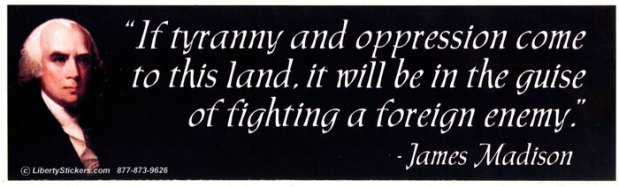
In a country fond of seeing itself as “the land of the free”, in the last couple decades, fear seems to have considerably tarnished this idealistic notion. We say we want freedom, but for whom? Too often, such notions suggest that we want freedom within the boundaries of what we idiosyncratically define as “US”—a term that has increasingly become more grounded in exclusivity than inclusion. This “US” comes to inform our socio-politically charged definition of freedom. In an attempt to stave off fear, our expectations are tinged by a new found xenophobia; we redefine a continually shrinking concept we used to refer to as “a free American”. In so doing, we open the door for those who would exploit our assumed sense of vulnerability. But when freedom does not apply to all, ultimately, it will fail to encompass any of us.
 “European democracies collapsed into right-wing authoritarianism and fascism in the 1920s and ‘30s… The European history of the twentieth century shows us that societies can break, democracies can fall, ethics can collapse, and ordinary men can find themselves standing over death pits with guns in their hands. It would serve us well today to understand why.”
So writes historian Timothy Snyder in his recently published book On Tyranny: Twenty Lessons from the Twentieth Century. On Tyranny is a tiny book, 126 pages measuring only about 4×6 inches. Each of the twenty suggestions forms a chapter consisting of only two to five pages.
Mr. Snyder does express certain biases (such as casting a jaundiced eye toward the Internet). However, for the most part, the book is largely written from a non-partisan perspective, focusing on various means of preserving freedom and staving off tyrannical control. As the book is quite easy to read, you can probably finish it in an hour (although you will likely ruminate over its contents for much longer).
Some of Snyder’s suggestions are expected (such as #3 – Beware the One-party State). Others are either surprising or defined in a thought provoking manner. For example:
- # 2 – Defend Institutions
- #10 – Believe in Truth
- #11 – Investigate
All address–directly or indirectly–some of the more hidden aspects of what is currently happening in the United States.
In a Washington Post review, Mr. Snyder’s book is described as “a slim book that fits alongside your pocket Constitution and feels only slightly less vital.” Some folks have been so taken with this little gem that they have bought multiple copies to distribute for free (a little over $6 on Amazon).
 Once you have read through the Snyder book a couple times you might, on reflection, find yourself thinking a bit differently about the state of affairs in the United States. While the twenty suggestions Snyder offers are pointed and helpful, the brevity of the book prevents comprehensive treatment of any idea. As such, you might want to follow-up Snyder’s book and expand your understanding the mechanism of tyranny by tackling the more in depth descriptions of “reality” in the U.S. by reading Requiem for the American Dream, Noam Chomsky’s new book. Professor Chomsky addresses tyranny from the perspective of identifying various tactics of oppression such as reducing democracy, attacking solidarity and marginalizing the population—all of which have been happening and continue to occur as you read this. Like On Tyranny, Requiem is easy to read, although not quite so brief.
Finally if you are really committed to understanding tyranny and how it might have been the underlying mode of governance in the United States for decades, consider Sheldon Wolin’s more challenging and comprehensive book Democracy Incorporated: Managed Democracy and the Specter of Inverted Totalitarianism.
 We constantly look to heroines or heroes to “save“ us. We wait for messiahs, we follow gurus and place considerable faith in politicians and other individuals, elevating them to the status of societal leaders, policy makers and ultimately gatekeepers of societal norms. Many of us dutifully cast our votes at election time, assuming our ballot can effectively shift the scales in our favor regarding civil liberties, personal protection as well as economic and physical well-being. Essentially, when it comes to getting things done, to make life better, we tend to look elsewhere instead of looking to ourselves.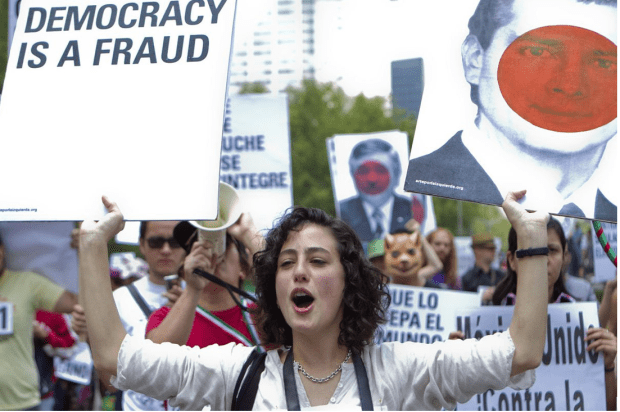

 Seeking Good